1. Deal the hand
Gin rummy is usually a two-player game. Each player receives 10 cards. The rest of the deck becomes the stock, and one card is turned face up to start the discard pile.
The face-up discard is public information. If your opponent takes it, you know that card probably helps their hand.
At a traditional table, the non-dealer gets the first chance to take the opening face-up card. If they pass, the dealer may take it. If both pass, the non-dealer draws from stock. After that opening choice, players alternate normal draw-and-discard turns.
2. Draw one card
Start your turn by drawing from one of two places:
- Stock: draw the top face-down card without showing it to your opponent.
- Discard pile: take the visible top discard. This is useful when it completes or improves a meld.
3. Build sets and runs
Your goal is to arrange cards into melds.
| Meld | Example | What it means |
|---|---|---|
| Set | 9-9-9 | Three or four cards of the same rank. |
| Run | 4-5-6 of one suit | Three or more cards in order in the same suit. |
Cards outside melds are called deadwood. Aim to reduce their total point value.
Keep your melds in your hand until someone knocks or goes gin; you do not put them on the table during normal turns. Aces are low: Ace–2–3 of one suit is a run, but Queen–King–Ace is not. Each card can belong to only one meld.
4. Discard one card
End every normal turn by discarding one card. A good discard usually does one of three things:
- Reduces your deadwood.
- Avoids giving your opponent an obvious meld card.
- Keeps flexible cards that can work in more than one future meld.
Drawing gives you 11 cards; discarding brings you back to 10. If you took the face-up discard, you must discard a different card on that turn.
5. Knock or go gin
After drawing, check your deadwood. If your deadwood will be 10 points or less after your discard, you may knock and end the hand. If all 10 cards fit into melds, you can go gin for a bonus.
You do not have to knock as soon as you can. Waiting can improve your hand, but it also gives your opponent time to knock first.
An example turn
Suppose you hold these ten cards and the face-up discard is the 6 of Hearts.
- Almost a run: 4 of Hearts, 5 of Hearts.
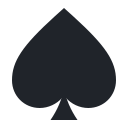
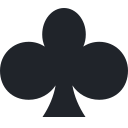
- A complete set: 7 of Spades, 7 of Clubs, 7 of Diamonds.
- A complete run: 9 of Clubs, 10 of Clubs, Jack of Clubs.
- Two other cards: 2 of Spades, King of Spades.


The two Hearts are not a meld yet. Along with the 2 and King, they count as deadwood: 4 + 5 + 2 + 10 = 21 points.
- Draw the 6 of Hearts. It completes your heart run. The stock might help, but you cannot see its top card before choosing it.
- Group 4–5–6 of Hearts. All three now belong to a meld, so they contribute zero deadwood. Keep your set of 7s and your club run together too.
- Choose the King of Spades as your discard. It costs 10 points outside a meld; the 2 costs only 2. Discarding the King leaves ten cards and reduces your deadwood to 2.
- Decide whether to knock. With 2 deadwood points, you can declare a knock as you discard the King. You may instead continue toward gin, but Gus could end the hand first.
If you knock, both players reveal their hands. Gus forms his own melds and may lay off unmatched cards onto yours. You then compare the remaining deadwood. See both hands and the complete 17-point calculation in the scoring guide.
Tips for your first hand
- Keep consecutive cards of the same suit, such as 6–7 or 9–10, when they can become a run.
- Be careful with high deadwood. Kings, queens, jacks, and tens are expensive.
- Watch what your opponent takes from the discard pile.
- Do not chase too many different melds at once.
- Consider knocking when your deadwood is low rather than always waiting for gin.
Related guides
Sources
Rules references: Bicycle Cards and Pagat.